

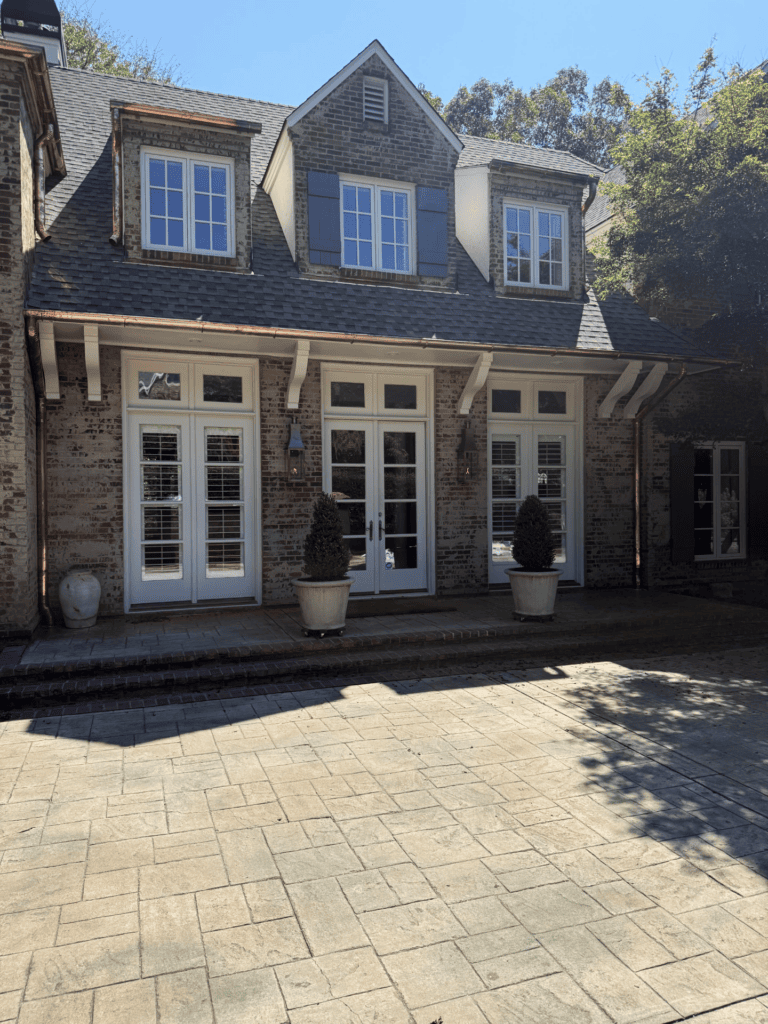
Drive through Mountain Brook, Homewood, or the older streets of Vestavia Hills after dark and you will notice a particular quality of light on certain front entries. It is warmer and less steady than an electric fixture, and it moves. That is an open flame behind glass, and it is one of the few exterior details that genuinely changes how a house reads from the street. We get asked about outdoor gas lanterns fairly often, usually in the middle of an exterior project when someone has been looking at their entry and decided the builder-grade sconce beside the door is not doing the house any favors. It is a good instinct. It is also a decision with some practical realities behind it that nobody mentions in the catalog photos, so here is the conversation we have with our clients before anyone orders anything.
How does a gas lantern actually work?
It is simpler than most people expect, which is part of the appeal. A supply line runs from your home gas service out to the fixture, terminating in a small burner inside the lantern housing. The flame burns openly against the air, without the mantle you would find on a camping lantern, and the glass panes around it protect it from wind while letting the light out. There is no bulb, no ballast, no photocell, and in the traditional configuration no electricity involved at any point. That absence is why these fixtures last the way they do. We regularly work on homes where the lantern hanging by the door was installed in the 1950s and has never been replaced, only cleaned and occasionally re-tipped, because there is almost nothing in the assembly that can fail. The light itself is warm and low, somewhere in the neighborhood of a candle or two rather than a floodlight, and it flickers because a real flame responds to every shift in the air around it. If you are expecting the fixture to light your walkway well enough to find your keys, it will not, and that is worth understanding before you spend the money. It is architectural light, not task light, and the homes where it works best usually pair it with low-voltage path lighting doing the practical work.
What does it cost to keep one burning?
This is the first question almost everyone asks, and the answer is more reasonable than people fear. Most residential fixtures of this kind burn somewhere between roughly twelve hundred and twenty-five hundred BTU per hour, depending on the size of the lantern and how the burner is set. At a middle-of-the-road burn rate running continuously, you are looking at roughly ten to eighteen therms of natural gas per month, which at recent Alabama residential rates works out to something in the range of fifteen to thirty dollars a month per fixture. Two lanterns flanking a front door will therefore show up on your bill, but not dramatically, and the number is fairly stable year to year compared with most household energy costs. We would encourage you to check the current per-therm rate on your own gas bill and run the arithmetic for the specific fixture you are considering rather than taking a general figure from anyone, including us, because burner sizes vary quite a bit between manufacturers and a large hanging lantern will cost noticeably more to run than a small wall-mounted one. If the house is on propane rather than natural gas, the math changes substantially and usually not in your favor.
Do they have to stay lit all the time?
Traditionally, yes, and there is a practical reason for it. The classic open-flame fixture has no ignition system, so once it is lit it simply stays lit, and turning it off means going out with a key or a valve and then relighting it by hand the next evening. Most people who live with these fixtures let them burn continuously and stop thinking about it, which is part of the character of the thing. That said, the market has changed and you have real options now. Electronic ignition systems can be added so the fixture lights itself on a timer or a photocell, shutting off during daylight and cutting your consumption roughly in half. Some manufacturers offer a dual-fuel or convertible design that runs on gas but can be switched to an electric insert. We generally tell people that if the running cost or the open flame gives them pause, an ignition system is money well spent, though it does introduce electrical components into an assembly whose main virtue was having none, and those components will eventually need service in a way the burner never will. There is no wrong answer here, only a tradeoff between simplicity and control.
Are they safe to have on a house with children and pets?
Broadly yes, with sensible siting. The flame is fully enclosed behind glass, the exterior of a properly designed fixture does not get dangerously hot to a brief touch, and because the burner runs continuously at a low, steady rate there is no ignition event and no accumulation of unburned gas. The genuine considerations are about placement rather than the fixture itself. We keep lanterns well clear of anything that will grow into them, since a climbing vine or an untrimmed shrub against hot glass is the realistic fire risk in this picture, not the flame. We keep them off low walls and away from railings where a child could reach the glass directly. We make sure any wall-mounted unit has adequate clearance above it, particularly under a wood soffit or a porch ceiling. The gas line matters more than most people realize as well. That connection needs to be run and pressure-tested by a licensed plumber, with a properly located shutoff valve you can actually reach, and permitted where your jurisdiction requires it. In Jefferson and Shelby Counties we handle that as part of the exterior scope rather than treating the lantern as a fixture swap, because a gas line into an exterior wall is not a decorative detail.
What kind of upkeep should I plan for?
Very little, but not none. The most common maintenance item is the burner tip, which gradually accumulates carbon and mineral deposits and will need cleaning or replacement every few years to keep the flame shaped correctly. A flame that has gone tall, smoky, or yellow and lazy is usually telling you the tip needs attention rather than signaling anything serious. The glass will collect soot on the inside and pollen and grime on the outside, and most people wipe it down once or twice a year. If your fixture is copper, and many of the good ones are, it will patina from bright penny to brown to eventually a soft verdigris over the course of years, which is generally considered the point rather than a problem, though it can be polished back if you prefer the shine. Beyond that, the things worth watching are the mounting and the connection. Check that the bracket has stayed tight and that no water is tracking into the wall where the fixture attaches, since an exterior penetration is an exterior penetration regardless of what is hanging on it. Handled that way, these fixtures genuinely will outlast most of what else is on your house, which is a rare thing to be able to say about anything we install.

Reliable Design-Build-Remodel is a full service general construction firm and remodeling contractor operating in the Birmingham metro and Jefferson and Shelby County areas and surrounding communities, including Birmingham, Helena, Chelsea, Mountain Brook, Hoover, Homewood, Montevallo, Alabaster, Vestavia Hills, and Pelham, with over 30 years of servicing our valued clients. Offering full service suite of general remodeling, design and build services. Our specialties include bathroom remodeling, kitchen remodeling, exterior renovations, interior renovations, painting, and more!
Visit us at reliablerem.com, and like and follow us on Facebook and Instagram!